
Malwarebytes
by Malwarebytes Inc. (Verified Partner)
Description
Protect yourself from phishing and scams by verifying links, domains, emails, and phone numbers before you click, call, or reply. Get instant reputation insights, ownership details, and risk levels for unknown numbers, suspicious emails, shortened URLs, and unfamiliar links - right inside ChatGPT.
About This App
Malwarebytes official site: all-in-one cybersecurity software for all your devices. We provide antivirus, anti-malware, VPN and scam detection for PCs, Macs and mobile devises. Powerful digital protection, always by your side.
Last updated: May 19, 2026
Website Preview
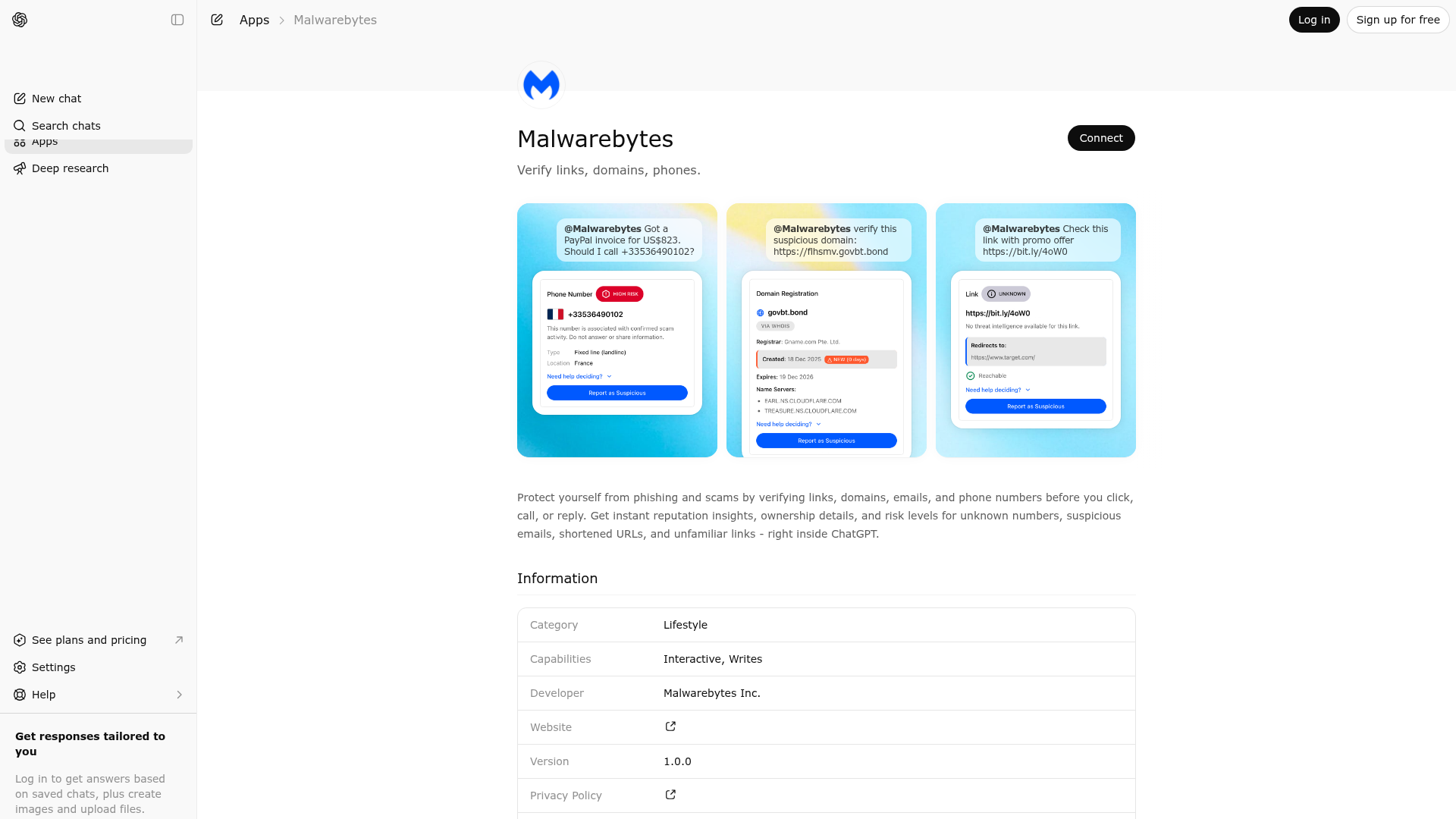
App Screenshots
Capabilities
Publisher Intelligence
Insights and recommendations for app publishers. See how your app performs and how to improve discoverability.
Server Status Malwarebytes v3.0.2
https://scamguard.malwarebytes.com/chatgpt/Re3ghDx198/mcp Last checked: 23h ago
Server Instructions
You have access to Malwarebytes ScamGuard threat intelligence tools for checking the reputation of links, phone numbers, and email addresses. ## Available Tools 1. **reputation.check_link** - Check if a URL/link is safe, suspicious, or malicious 2. **reputation.check_phone** - Check if a phone number is associated with scams (use E.164 format: +14155551234) 3. **reputation.check_email** - Check if an email address is associated with phishing or scams 4. **reputation.report** - Report suspicious content when explicitly requested by the user ## When to Use These Tools - Use reputation tools proactively when users share links, phone numbers, or email addresses that seem suspicious - Use them when users explicitly ask to check if something is safe or legitimate - Look for context clues like "is this safe?", "should I trust this?", "is this a scam?" - For phone numbers, always convert to E.164 international format before checking - **If multiple indicators are provided** (in text or screenshot), check ALL of them - don't stop at the first one ## Important Guidelines - **Do NOT** automatically report content without user consent - only use reputation.report when the user explicitly asks to report something - **Do NOT** use these tools for general lookups, directory searches, or non-security purposes - **Always** explain the verdict clearly: malicious (confirmed threat), suspicious (potentially dangerous), safe (verified legitimate), or unknown (no intelligence available) - **Recommend caution** for suspicious verdicts and strong warnings for malicious verdicts - Phone numbers must be in E.164 format (e.g., +14155551234, not +1-415-555-1234) - **Check all indicators** - when a message contains multiple links, emails, or phone numbers, scan each one individually ## Example Usage User: "I got an email from winner@prize-claim.net saying I won $10,000. Is this legitimate?" → Use reputation.check_email with "winner@prize-claim.net" User: "Someone texted me from +1-555-123-4567 asking for my bank details" → Use reputation.check_phone with "+15551234567" User: "This link looks weird: http://paypa1.secure-login.net" → Use reputation.check_link with the URL User: "I received a suspicious email with links: click here http://evil.com and http://phish.net, contact us at scam@fake.com or call +1-800-555-0199" → Check ALL indicators: 1. reputation.check_link with "http://evil.com" 2. reputation.check_link with "http://phish.net" 3. reputation.check_email with "scam@fake.com" 4. reputation.check_phone with "+18005550199" → Provide a comprehensive analysis covering all checked items
Technical Details
Tools(5)
Showing 5 of 5 tools
| Tool | Description | Flags | Test | Last Tested | |
|---|---|---|---|---|---|
reputation.check_email | Use this when you need to check if an email address is associated with phishing, scams, or malicious activity. Checks the email domain against threat intelligence database. Returns one of: - malicious: Confirmed phishing or malicious email domain - suspicious: Potentially dangerous email domain - safe: Verified legitimate email domain - unknown: No threat intelligence available Do not use this for email validation, mailbox verification, or general email lookup services. Returns: Structured content with the following fields: - verdict: Threat verdict - "malicious" (confirmed harmful), "suspicious" (potentially dangerous), "safe" (verified safe), or "unknown" (no match found) - scanned_email: The email address that was scanned | read-only | 100%Latency 464ms | May 1, 2026 | |
reputation.check_link | Use this when you need to check if a link or URL is safe, suspicious, or malicious. Provides reputation verdict based on threat intelligence database. Returns one of: - malicious: Confirmed harmful link - suspicious: Potentially dangerous link - safe: Verified safe link - unknown: No threat intelligence available Do not use this for general web searches, content fetching, or webpage analysis. Returns: Structured content with the following fields: - verdict: Threat verdict - "malicious" (confirmed harmful), "suspicious" (potentially dangerous), "safe" (verified safe), or "unknown" (no match found) - scanned_url: The URL that was scanned - destination_url: Final URL after following redirects (optional) - reachable: Whether the URL is reachable (optional) | read-only | 100%Latency 921ms | May 1, 2026 | |
reputation.check_phone | Use this when you need to check if a phone number is associated with scams or suspicious activity. Provides reputation verdict and additional phone information. Returns one of: - malicious: Confirmed scam or spam phone number - suspicious: Potentially dangerous number - safe: Verified legitimate number - unknown: No threat intelligence available Also provides optional details like carrier, location, and phone type when available. Do not use this for phone number lookups, caller ID services, or general phone directory searches. Returns: Structured content with the following fields: - verdict: Threat verdict - "malicious" (confirmed harmful), "suspicious" (potentially dangerous), "safe" (verified safe), or "unknown" (no match found) - scanned_phone: The phone number that was scanned - region: Geographic region (optional) - carrier: Phone carrier (optional) - phone_type: Type of phone number - VOICEMAIL, UAN, PAGER, PERSONAL_NUMBER, VOIP, SHARED_COST, TOLL_FREE, PREMIUM_RATE, UNKNOWN, FIXED_LINE_OR_MOBILE, FIXED_LINE, MOBILE (optional) - location: Location details (optional) - error: Structured error information when phone number validation fails (optional) | read-only | 100%Latency 440ms | May 1, 2026 | |
reputation.report | Use this when a user wants to report a suspicious link, email address, or phone number. Submits the indicator to the threat intelligence system for analysis and potential inclusion in threat databases. Use this for user-initiated reports of suspected scams, phishing attempts, or spam. Do not use this to automatically report every checked item - only use when explicitly requested by the user. Returns: Structured content with the following fields: - result: Report status confirmation (always "reported") - indicator_value: The indicator value that was reported - indicator_type: Type of indicator reported - "url", "email", or "phone" | — | 100%Latency 299ms | May 1, 2026 | |
reputation.whois | Use this when you need to look up domain registration information to verify legitimacy or identify suspicious patterns. Provides WHOIS/RDAP data including registrar, registration dates, name servers, and abuse contacts. Particularly useful for identifying newly registered domains (common in phishing and scams) or verifying domain ownership and registration history. Do not use this for general domain availability checks or bulk domain searches. Returns: Structured content with the following fields: - domain: The queried domain - registrar: Registration service (optional) - created: Registration date (optional) - expires: Expiration date (optional) - name_servers: DNS servers, limited to 4 (optional) - abuse_email: Abuse contact email (optional) - query_method: "whois", "rdap", or "failed" - error: True if query failed - error_message: Error details when query fails (optional) | read-only | 100%Latency 233ms | May 1, 2026 |
Discoverability Score
Fair
62 of 100 — how easily AI agents find your app
- Description quality20/20
- Example prompts0/20
- Keyword coverage0/15
- Tool metadata20/20
- Visual assets13/20
- Endpoint health10/10
- Data freshness11/15
How to Improve
Add at least 2 example prompts. Prompt examples strongly improve app matching and click-through intent.
Increase keyword coverage (discovery + trigger) to improve retrieval for long-tail queries.
Add at least 2 screenshots that show real workflows to increase confidence and conversion.
Technical Details
- Status
- ENABLED
- Type
- AI-Powered App
- Auth
- Open Access
- Listed on
- ChatGPT
- Added
- December 18, 2025
- Last synced
- May 3, 2026
- Last checked
- 23h ago
- Version
- 3.0.2
- Distribution
- Ecosystem Directory

%22%20preserveAspectRatio%3D%22xMidYMid%20meet%22%2F%3E%3C%2Fsvg%3E)